

What is the weight of ABS edge banding per unit length?
Oct 15, 2025
Leave a message
What is the weight of ABS edge banding per unit length?
As a seasoned supplier of ABS edge banding, I've encountered numerous inquiries from customers about the weight per unit length of our products. This seemingly straightforward question is crucial for various applications, from furniture manufacturing to interior decoration. Understanding the weight of ABS edge banding helps in estimating material usage, shipping costs, and overall project budgets. In this blog post, I'll delve into the factors that influence the weight of ABS edge banding per unit length and provide some practical insights.
Factors Affecting the Weight of ABS Edge Banding
The weight of ABS edge banding per unit length is primarily determined by several key factors:
-
Thickness: One of the most significant factors influencing the weight is the thickness of the edge banding. Generally, thicker edge banding weighs more per unit length. For example, a 2mm thick ABS edge banding will be heavier than a 1mm thick one of the same width and length. This is because more material is used in the manufacturing process, resulting in increased mass.
-
Width: Similar to thickness, the width of the edge banding also plays a role in determining its weight. A wider edge banding will have a greater cross - sectional area, which means more material and a higher weight per unit length. For instance, a 60mm wide ABS edge banding will be heavier than a 20mm wide one with the same thickness.
-
Density of ABS Material: The density of the ABS (Acrylonitrile Butadiene Styrene) material used in the edge banding is another critical factor. Different grades of ABS can have varying densities, which directly affect the weight. High - quality ABS materials with a higher density will result in heavier edge banding per unit length compared to lower - density alternatives.
-
Additives and Fillers: Some ABS edge bandings may contain additives or fillers to enhance certain properties such as durability, flexibility, or color. These additives and fillers can increase the overall weight of the edge banding. For example, if a filler material with a high density is added, the weight per unit length will be higher.
Calculating the Weight of ABS Edge Banding per Unit Length
To calculate the weight of ABS edge banding per unit length, you can use the following formula:
[ Weight = Volume\times Density ]
The volume of the edge banding per unit length can be calculated as the product of its cross - sectional area (thickness × width) and the unit length. For example, if you have an ABS edge banding with a thickness of (t) (in meters), a width of (w) (in meters), and a unit length of (L = 1) meter, the volume (V) is (V=t\times w\times1=t\times w) (in cubic meters).
Let's assume the density of the ABS material is (\rho) (in kilograms per cubic meter). Then the weight (m) of the edge banding per unit length is (m = V\times\rho=t\times w\times\rho) (in kilograms).
For example, if the thickness (t = 0.002) meters, the width (w = 0.02) meters, and the density of the ABS material (\rho = 1050) kg/m³, the weight per unit length is:
[m=0.002\times0.02\times1050 = 0.042] kg or 42 grams.
Real - World Examples of ABS Edge Banding
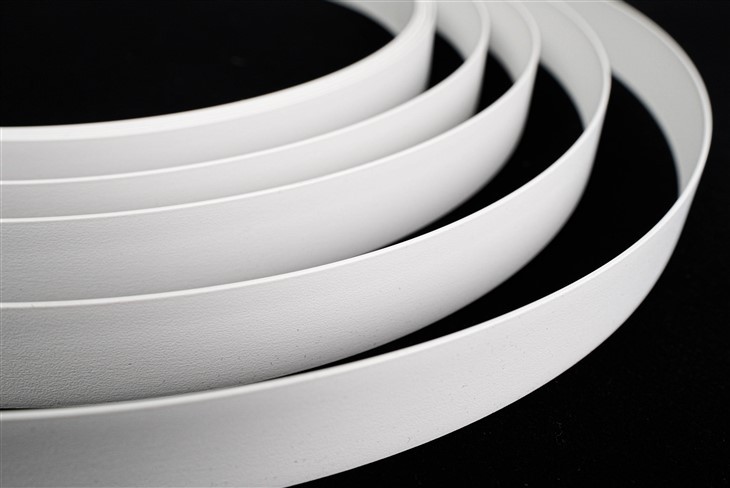
We offer a wide range of ABS edge banding products, each with its own unique weight characteristics. For instance, our EGGER 2024 EDGE BANDING W1100 PM Alpine White has a specific thickness and width that determine its weight per unit length. This high - quality edge banding is made from a premium ABS material, which gives it a consistent density and predictable weight.
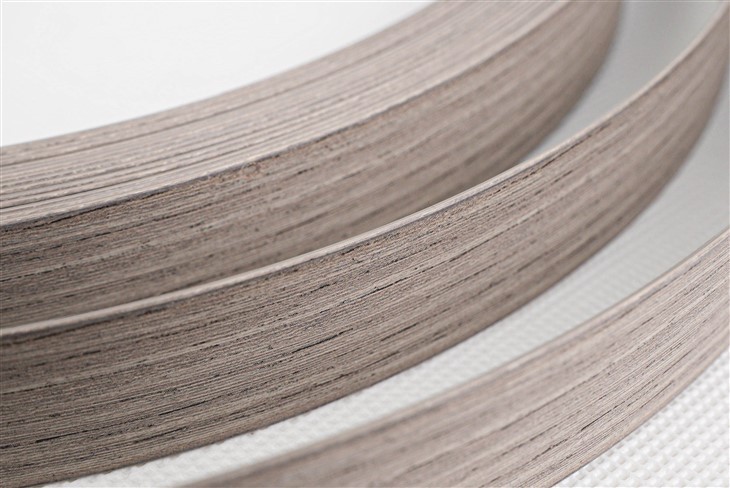
Another popular product is the H1288 ST19 Stone Grey Frozen Wood CT10039M EA16282. Its unique design and material composition result in a different weight compared to other edge bandings. The color and texture of this edge banding are carefully crafted, and the weight per unit length is an important consideration for customers who need to manage their material usage accurately.
Our U775 ST9 WHITE GREY CT10066M EA16309 is also a well - known product in the market. The weight of this edge banding is optimized to provide a good balance between durability and ease of handling. Customers can rely on its consistent weight per unit length for their projects.
Importance of Knowing the Weight per Unit Length
Understanding the weight of ABS edge banding per unit length is essential for several reasons:
-
Material Estimation: Furniture manufacturers and interior designers need to accurately estimate the amount of edge banding required for a project. By knowing the weight per unit length, they can calculate the total weight and quantity needed, which helps in ordering the right amount of material.
-
Shipping Costs: Shipping costs are often calculated based on weight. Knowing the weight per unit length allows customers to estimate the shipping costs more accurately, which is important for budgeting purposes.
-
Installation Considerations: The weight of the edge banding can also affect the installation process. Heavier edge banding may require more secure fastening methods to ensure proper adhesion and durability.
Conclusion
In conclusion, the weight of ABS edge banding per unit length is influenced by factors such as thickness, width, density of the ABS material, and the presence of additives or fillers. By understanding these factors and using the appropriate calculation methods, customers can accurately estimate the weight of the edge banding they need for their projects.
As a leading supplier of ABS edge banding, we are committed to providing high - quality products with consistent weight characteristics. Our team of experts is always available to assist you in selecting the right edge banding for your specific needs and answering any questions you may have about weight, installation, or other aspects of our products.
If you are interested in purchasing our ABS edge banding products or have any inquiries regarding weight or other product features, please feel free to reach out to us. We look forward to discussing your project requirements and helping you find the best solutions.
References
- "Plastics Engineering Handbook", Various authors, Published by McGraw - Hill.
- "ABS Polymer: Properties and Applications", Research papers from polymer science journals.
- Internal product specifications and manufacturing data from our company.